Prices subject to change without notice
*Price includes U. S. customs duty, processing fees, currency-conversion fees, and shipping & insurance from the manufacturer to our office in the USA
*UPS Ground insured within the contiguous 48 states. We combine shipping with multiple items, offer expedited shipping, and ship to other locales inside or outside the USA. Please see full shipping options, terms & conditions.
Buzz Rickson white-space: nowrap">U. S. Army Mountain Field Jacket, 1942: Founder’s Favorite!!!
Buzz Rickson white-space: nowrap">U. S. Army Mountain Field Jacket, 1942: Founder’s Favorite!!!
Prices subject to change without notice
*Price includes
U. S. customs duty,
processing fees, currency-
conversion fees and
shipping & insurance from
the manufacturer to the USA.
*UPS Ground insured within the contiguous 48 states. We combine shipping with multiple items, offer expedited shipping, and ship to other locales inside or outside the USA. Please see full shipping options, terms & conditions.
- Product Information
- Sizing Tips
- Product Measurements
- Measuring Garments
- Body Measuring
- Product Information
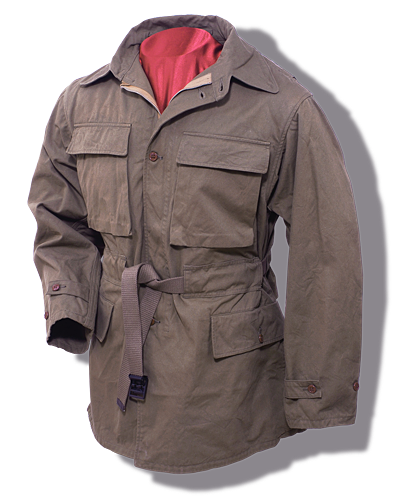
At the outset of WWII, the white-space: nowrap”>U. S. Army developed highly specialized troops for mountain fighting. These troops were made up mostly of rugged outdoorsmen with exceptional athletic skills, snowy, cold-weather survival abilities and expertise in skiing, snowshoeing, and marksmanship, and who possessed higher intellect than the average soldier. These mountain troops required new, specialized clothing and gear to match the nature of the special operations they were being trained to engage in and their basic combat uniform was built around the layering principle, where lighter-weight outer clothing would form the basis under which a variety of warmer layers could be added as the conditions warranted, with various combinations of wool shirts and sweaters of different weights being the mainstay of the layering system for mountain troops; when not being worn they could be stowed in the built-in backpack. What followed was the most practical, functional, sharp-looking, unique field jacket ever designed at that time for the white-space: nowrap”>U. S. Army, and possibly even since that time.
The Mountain Field Jacket of 1942 has largely been ignored by manufacturers who engage in producing such military styles, and on the few occasions it has been made available, the level of historical detailing and true functionality was lacking, but Buzz Rickson’s has now changed all of that. This Mountain Field Jacket presents all of the rugged, unique, utilitarian features of the original design with a heavy emphasis on crafting a garment that would pass the exact same standards found in the 1942-dated white-space: nowrap”>U. S. Army spec.
True, standout features include the following: two-button closure on cuffs to keep out gusty winds, two chest pockets with zipper closure and storm flap to seal in food rations or other objects, two very large lower pockets with button-down flap for stowing a wide variety of items, storm hood that neatly can be secreted into its own compartment in the back neck area on the shoulder yoke when not in use, bi-swing pleated back for unrestricted movement that doubles as a built-in backpack with zippered side entry, built-in internal, heavyweight, adjustable suspenders to support heavy loads in the built-in back pack, removable canvas web belt to secure jacket front, storm flap over zipper closure on jacket front to keep ice and wind from contacting the zipper, double-thickness, high-density poplin construction that is basically canvas weight and nearly indestructible, and reinforced collar stitching with heavy interlining. Just as per the original design, the jacket is cut large enough for multiple layers to be added and then removed and stowed in the builtin backpack.
This jacket design is a favorite of our founder, with the sum total of all the many parts making this design the ultimate air-traveler’s or hiker’s coat today: the many pockets, and especially the built-in backpack, easily provide for stowing two day’s worth of food, gloves, shirts, sweaters, vests, socks, pants, underwear, and toiletries or other necessary items for business (USB cables, laptop, tablet, phone, batteries, chargers, etc.) so that one can cutdown on the number of carryon bags for air travel and get away with a FREE carryon in the form of the jacket one is wearing!!! That’s right – this coat holds so much in the pockets and backpack that one can save on extra fees for baggage and travel with peace of mind in the event bags may get delayed because of all the extra gear that can be carried on one’s person.
The heavy-duty built-in suspenders are designed to support quite a heavy load in the side-loading, built-in backpack, and the removable, heavyweight web belt can be made as tight as you need to further support the lower back and the load in the backpack; when the backpack is not in use, the belt can still be buckled closed or simply knotted in casual fashion for easy donning and removal of the coat.
This jacket design was ahead of its time in 1942 and among the most costly jackets to be produced for the white-space: nowrap”>U. S. Army ground forces; today, it is even more costly to make correctly due to the antiquity of the many parts and machines needed to recreate it exactingly. Please note these additional features that make this Buzz Rickson’s masterpiece Mountain Field Jacket not just the most practical, functional, useful, sharp-looking jacket you are likely to find, but one of superior quality and unprecedented historical accuracy:
• Custom manufacturing of the correct double-thickness, heavyweight, high-density, canvas-like poplin shell on vintage looms to precisely match 1941 white-space: nowrap”>U. S. Army specs. and dyed a correct shade of Olive Drab #2.
• Genuine urea buttons to match white-space: nowrap”>U. S. Army specs. in fabrication and color, not cheap plastic.
• Custom manufacturing of the correct 8-ounce cotton twill for the lower-pocket linings.
•Exact copy of a 1942-style, nickel-plated Talon zipper with zip tape made of 100% cotton HBT fabric, not incorrect poly-cotton: one on the frontal closure and one on side-entry, built-in backpack.
•Exact copy of a 1942-style, brass-plated Talon zipper with zip tape made of 100% cotton HBT fabric, not incorrect poly-cotton: one on each of two chest pockets.
•Storm hood with drawstring and triple-button face shield that neatly stows away in its own slotted pouch at the top of the back shoulder yoke under collar.
•Storm flap covering zipper to keep wind from penetrating and ice forming on zipper.
•Adjustment tab on each sleeve end.
•Exact copy of correct 60″, heavyweight web belt with oxide-coated metal buckle for securing heavy loads and tightening the coat around the wearer’s waist.
•Heavyweight, built-in, adjustable suspenders in lining for supporting heavy loads in the built-in backpack
•Zipper-closure, side-entry built-in backpack with gusseted sides; when backpack is not in use, the bi-swing gussets provide for greater range of motion.
•Exact copy of the original-style 1942 contractor printed label in lower right pocket.
Even sizes 36-44. Please see our SIZING TIPS for advice on how to get the correct fit in this unique jacket style.
Buzz Rickson goods are imported from Japan
- Sizing Tips
SIZING TIPS
About this Style: This jacket style is cut full to allow for ample layering, but even if you plan to not wear much under this style, we do NOT recommend deviating from following the sizing information that follows.
It is important to keep in mind that this jacket style is made from two layers of high-density, heavyweight poplin that is almost like canvas, and this fabric, in conjunction with the internal suspenders and external backpack, make it more rigid and contribute to less internal space than the measures may lead one to think exists. As always, the external chest measures listed here are just that – EXTERNAL measures – and don’t account for the lesser amount of room on the inside of the jacket, especially if you plan to wear heavy layers under this jacket style; that application will further subtract from the room inside the jacket. However, if you follow the Sizing Tips, this style can be a very easy-wearing coat that creates very few sizing issues for the overwhelming majority of individuals.
Tip 1: Follow the instructions entitled “How to Use Product Measures to Obtain a Good Fit” listed under the PRODUCT MEASUREMENTS tab for this product. After finding no substantive conflicts with your body measures obtained from the tab entitled BODY MEASURING, order this garment with 5″ – 6” of external room in excess of your chest measure if you prefer a comfortable fit in the chest and shoulders. Even those with lean builds should not order this jacket with less than 5″ – 6” of room in the chest so as to allow for the internal suspenders and built-in backpack. If a roomier or longer fit is desired, then order the next available size after reviewing all relative measures that pertain to that size. It is best advised for most customers to order a size that directly equates to their chest measure: Chest measures 40”, order size 40. Those whose chest measure falls on an odd number, such as 41” or 43”, will have to determine if they want less room or more room when selecting a jacket size.
Tip 2: Please note that your chest circumference measure is not necessarily the labeled size you wear in another jacket you may own from a different maker or even the same maker, so please take the time to obtain your true chest circumference measure so as to compare to our chart of jacket measures; this will enable us to perform a better job getting you the right size and minimize your chances in having to deal with the hassle and cost of exchanges.
Please ask us for fitting advice if in doubt.
Tip 3: This style lends itself best to lean and medium-build individuals; those with a hefty build, especially in the mid-section, may find this style too restrictive and confining. Individuals who prefer looser fits and/or those with a waist measure that is nearly equal to or greater than their chest circumference measure may jump up one – two sizes in this jacket for comfort and desired fit (when we refer to waist measure we do not mean your trouser size; we mean the actual circumference measure of your waistline at its widest point). If you are unsure of the size to order we will assist you; please contact us with the following information: Height, waist circumference measure, chest circumference measure, body weight, and type of clothing to be worn beneath the jacket most of the time, as well as the type of fit you prefer: Trim, roomy or oversized.
- Product Measurements
PRODUCT MEASUREMENTS
The following table provides actual product measures. These measures are provided as an aid because, in conjunction with the information found under the SIZING TIPS tab for each product, they can sometimes be very useful when comparing the measurements from this garment to the measures of your body; however, acting as an armchair tailor should be done with caution, as well as with knowledge of other important areas of fit that are not displayed here. Armchair tailors frequently fail to take into account other significant elements that impact fit; following the information found under the SIZING TIPS tab for each garment on this web site is strongly suggested, which can be very useful in supplanting or supplementing the listed measures below.
Our measures were derived from averaging measurements taken from many garments of the same size from each specific size in the range of any given product, thus the measures provided are representative for each size but they may not be exactly what you will receive. Some fluctuation in size is normal and to be expected, especially in these garments that have been manufactured on the bench by hand. Size fluctuations are rarely encountered in the width measures and more typically encountered in length measures, and particularly with respect to leather jackets and jackets with knit cuffs and waistbands. Fluctuations in width measures are very rare, and when they are encountered they are typically insignificant: 1/8” – ¼”. Normal fluctuations in sleeve and/or body length + /- a ½” are more common but still rare, and such fluctuations in that increment range are within spec. for jackets of the same size and style.
This MA-1 Jacket is available in either a Regular-Length fitting or a Long-Body fitting (only the body length increases versus the Regular-Length fitting).
Size 36 38 40 42 44 46 48 Chest width 21″ 22″ 23″ 24″ 25″ Shoulder width 18″ 19″ 20″ 21″ 22″ Arm length 22.5″ 23″ 24″ 24.5″ 25.5″ Back length 29.5″ 30.5″ 32″ 33″ 34.5″ How to Use the Product Measures to Obtain a Good Fit:
1) Using the measurements listed for this product and information found under the tab entitled MEASURING GARMENTS to understand our measuring technique, please double the chest measure to obtain the total external chest circumference of this garment. For example: If the chest measure listed for size 40 is 23”, doubling this measure yields a 46” external chest circumference.
2) Measure your chest circumference as per the tab on this web site specifically addressing BODY MEASURING, then compare your chest measure to the chest measure of this product.
3) Many jackets are cut in such a way that the wearer requires no less than 4” of room in the jacket for a sleek fit that is also comfortable, while other jacket styles require the wearer to have more than 8” of room. If your chest circumference is 40”, a product with a 23” chest width has a 46” external chest circumference and would provide 6” of external room in this scenario (chest measures 40”, external chest measure of jacket is 46”, thus 6” of external room would be realized).
4) Again, using the measurements listed for this product and information under the MEASURING GARMENTS tab to understand our measuring technique, add half of the shoulder width to the arm length. For example: If the shoulder width is 18” and the arm length is 25”, adding 9” (half the shoulder width) to 25” (the arm length) will yield an overall sleeve length of 34” in this product.
5) Measure your overall sleeve length following the instructions on this web site under the tab specifically addressing BODY MEASURING, then compare your overall sleeve length to this product.
6) If desired, repeat the measuring comparisons for back length.
7) Compare your body measures to the listed garment measures and follow the advice found under the SIZING TIPS tab to obtain a good fit.
IMPORTANT NOTE: Because you need room in a garment for comfort, garments with a 44” chest circumference are NOT a size 44, nor are they intended for anyone with a 44” chest circumference. Tee shirts and thermal shirts tend to have the most body-hugging fits of our product offerings because these were originally intended to be undergarments, thus these can be ordered to stretch to fit if that is how you wish to wear such garments. Other shirts, sweatshirts, sweaters, jackets, etc. will all have some amount of room incorporated in their designs, thus these will all measure larger than your actual chest measure by varying degrees.
Sometimes-Problematic Way to Determine a Good Fit:
Due to differences in how even near-identical garments are cut by different manufacturers, it is not necessarily a good idea to compare the listed measures of this product to the measures of an existing, similar product in your wardrobe to determine the correct size to order in this product. Though such comparisons can indeed work some of the time, and maybe even most of the time, vast experience with and knowledge of the products we market has proven such practices will sometimes fail. This inaccurate measuring methodology doesn’t factor in other key variables of fit relative to you and the garment that includes: Armhole opening, shoulder slope, high-point shoulder, high chest, width of sleeves at all points including the all-important elbow, waist measure, and the thickness, plumpness, and rigidity of the material the garment is made from, naming just some variables influencing fit that do not appear on any list of measurements for a garment or that a customer is likely to account for.
It is best to compare your actual body measures to the listed measures of this product AND follow our advice listed under the SIZING TIPS tab specific to this product to obtain a good fit in this style.
A Good Fit:
This is highly subjective – what one person may think is too big, another may think fits perfectly. Some garments are cut quite generously and others are cut quite trimly. If comparing measurements of one of our products to another you may own, some individuals will surely find that none or maybe only one area of measure is commonly shared or remotely close to being the same. Ultimately, chest measure is the most important area to properly fit, then all other areas of measure will have to fall into place. And some individuals who are extremely tall may find that body and/or sleeve length are more important to accommodate than even chest measure.
It is best to compare your actual body measures to the listed measures of this product AND follow our advice listed under the SIZING TIPS tab specific to this product to obtain a good fit in this style.
We strive to create a crisp fit between our products and the customer, and not a loose, sloppy look. If you prefer your clothing to fit more loosely, then we will do our best to work with you to that end, though, by the very nature of our product designs and fits it may not be possible to duplicate the slack looks found in many mainstream clothing brands even if you go up one or two sizes in our products.
- Measuring Garments
MEASURING GARMENTS
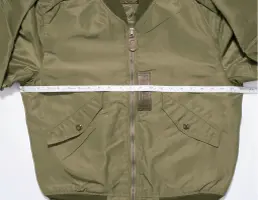
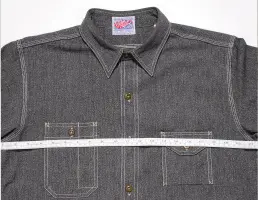
This section will explain and illustrate the measuring techniques we employed to derive the garment measurements found under the PRODUCT MEASUREMENTS tabs related to each of our products; additionally, this section provides the educational tools to enable the accurate measuring of any garments you may have access to for comparison. Garment measurements are invaluable when used in conjunction with the instructions found under the tab BODY MEASURING, as well requisite for following our advice found under the tab SIZING TIPS.
Please click on the appropriate link below that relates to the product category for which you wish to ascertain garment-measuring instructions:
- Body Measuring
BODY MEASURING
Measuring for Jackets and Shirts
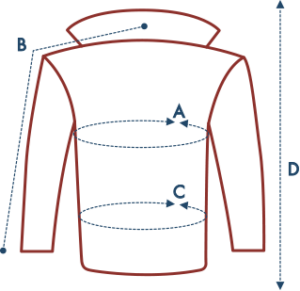 Please take these measures wearing just a thin shirt or undershirt or with no shirt at all. Simply note the following measures on a sheet of paper so you can comapre your findings to our listed measurements found under the PRODUCT MEASUREMENTS tab or so you can request assistance from us. Please always refer to the information found under the SIZING TIPS tab that is specific to each product.
A) CHEST—Measure high under armpits, spanning the widest part of your chest, then wrap tape around for one 360-degree complete circumference measurement.
B) SLEEVE – Measure from the nape of the neck to the shoulder edge, then down the arm to the bottom of the wrist bone.
C) WAIST – Measure the widest part of your waistline for a complete 360-degree circumference measurement.
D) HEIGHT – Your total overall height
E) BODY WEIGHT – Your total body weight
A Good Jacket Fit
There is no industry standard for grading size: Any jacket we offer in, say, size 42, may very well not be the same measure as another jacket of the exact same size made by a different company, or even if made by the same company. Ultimately, chest measure is the most important area to properly fit, then all other areas of measure will have to fall into place. And some individuals who are extremely tall may find that body and/or sleeve length are more important to accommodate than even chest measure.
Do NOT attempt to guess your size in our jackets, and please understand that no jacket can be two jackets in one (you may have to make a compromise in fit somewhere). The best look is achieved wearing a shirt and undershirt, or a medium-weight sweater with undershirt; the goal being a trim, sleek look. If the application of our jackets is with multiple layers of clothing, then the original look will be compromised. When purchased oversized, please keep in mind that the jacket will fit NOT trimly but LOOSELY when fewer clothes are worn.
It is best to compare your actual body measures to the measurements of one of our products found under the tab
PRODUCT MEASUREMENTS, then follow our sizing pointers found under the tab SIZING TIPS, which are specific to each product. And never be reluctant to ask us for sizing advice; we’re here to help you get the best fit possible!As a rule here, if the jacket squares up nicely on the shoulders when worn with the sort of clothing you will wear most of the time, falls about 1 1/2″ below the top of your trousers (if a waist-length jacket), allows you to reach into trouser pockets and recover keys, wallet and change without discomfort or pain, as well as allow normal strides while walking, then this is very likely a good fit and how the jacket would have been worn when originally issued.
Using the good-fit test where one draws their arms across their chest as a barometer for snugness will almost certainly produce some binding in an A-2 jacket of the correct size, and thus push you further up the sizing scale into a very large A-2 jacket. A true 1940s A-2 jacket has no bi-swing action back (as found on the USN M-422A or G-1jackets, USAAF B-6, Tanker jacket, etc.) and is not cut for such a great range of movement as experienced when doing the arm-crossing act. If you can get that sort of movement range without binding in one of our A-2s, then it will surely be rather loose and sloppy when you aren’t drawing your arms across your chest in front of you.
What makes more sense, having a jacket that looks great and feels fine during 90% of your activities, or only when you cross your arms in front of you? Do you walk around with your arms crossed in front of you? The choice is yours and we will gladly oblige all tastes, but do try to get the look originally intended.
Measuring for Caps
 Caps – Measure the circumference around the widest portion of the head just above the ears and brow where the cap will sit. The number you derive from this exercise must be converted to a numerical cap size. Please use the chart below to convert your head circumference measure to a numerical cap size, which will then enable you to following the SIZING TIPS for our caps to place and order.
If you need any assistance, please contact us.
Head Circumference Inches Head Circumference Centimeters Hat Size 22″ 56 cm 7 22 3/8″ 57 cm 7 1/8 22 3/4″ 58 cm 7 1/4 23 1/8″ 59 cm 7 3/8 23 1/2″ 60 cm 7 1/2 Measuring for Gloves
 Gloves – Measure the circumference around the widest portion of the knuckles (excluding thumb) while holding your hand flat. The number you derive, say, 9”, is your numerical glove size. With select glove styles on this web site we ask you to provide us with this number derived from measuring your hand knuckle circumference, then we’ll make the correct size selection for you in conjunction with your input. Where we request this information, please provide the true number even if your hand measure falls between numbers, say, 9 ¼”; you’ll be able to add a memo to your order in the checkout process informing us as to the details of your hand measure and we’ll intereact with you to determine if rounding this number up is the best choice. Always follow the SIZING TIPS for each product to determine what you need to know for ordering.
If you need any assistance, please contact us.
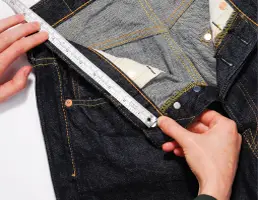
Measuring for Jeans and Trousers
A) WAIST – Using a tape measure, measure the full circumference in a 360-degree circle around your waistline where you plan to you’re your jeans or trousers (if you have a large mid-section but plan to wear the jeans or trousers below your belly, then measure the area where you will wear the jeans or trousers). It is sometimes better to measure the widest portion of your waistline regardless of where you actually where your jeans or trousers, which is the case when measuring yourself for a jacket or shirt. Always follow the SIZING TIPS for each product to determine where it is best that you should measure.
B) INSEAM – While wearing the footwear you normally would have on with the jeans or trousers you plan to order, measure your inseam length with a measuring tape beginning at the highest point of either inside leg up in the crotch area and measure down the inside leg to where you want the trousers or jeans to end; the measure you derive is your inseam length. This measuring exercise is best performed by another individual while you are standing upright with you legs straight. You may compare your inseam length to the PRODUCT MEASUREMNTS specific for each product found under the tab of this same name or on the PRODUCT INFORMATION tab.
You may also want to compare other areas of fit for each product, such as front rise or thigh width, which are found under the PRODUCT MEASUREMNTS tab specific to each product.
If you need any assistance, please contact us.
* Prices subject to change without notice.
* Ground insured within the contiguous 48 states. We combine shipping with multiple items, offer expedited shipping, and ship to other locales inside or outside the USA. Please see full shipping options, terms & conditions. Please see full shipping options, terms & conditions.